
MEPS for Lighting in South Africa: From Lamps to Luminaires
Energy performance rules for lighting began with lamps. Streetlights are next, and a regional standard could eventually reach the fittings in offices, shops and homes.
If you supply lighting in South Africa, you’ll know that minimum energy performance standards (MEPS) for lamps have been coming for a while. What fewer suppliers realise is that MEPS for lighting is no longer only about lamps. A draft compulsory specification for streetlights, VC 9118, is already in the works. And a regional standard, SADC HT 109:2021, covers luminaires as well, including the downlights, battens and panel lights found in homes, shops and offices.
This article sets out what has been proposed so far, and what it could mean for your product range.
Key takeaways
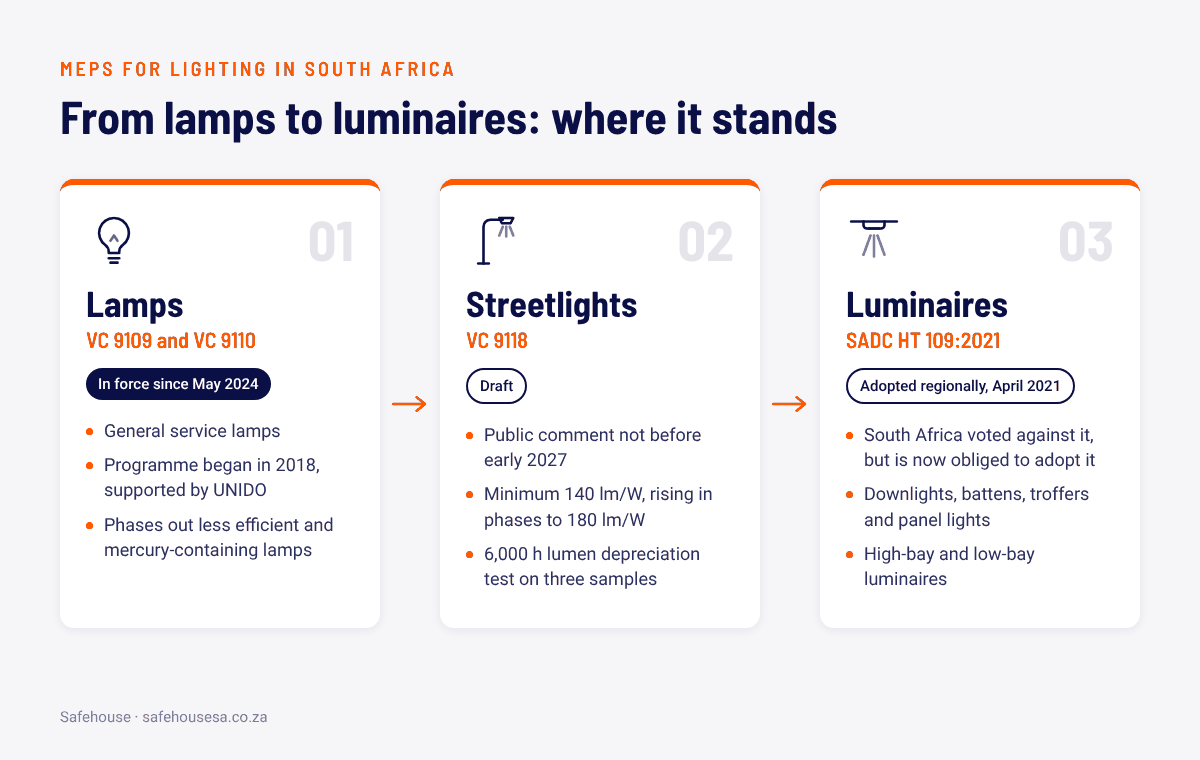
- Lamps came first. VC 9109 and VC 9110, the compulsory specifications for general service lamps, have been in force since May 2024.
- VC 9118 proposes a minimum efficacy of 140 lm/W for streetlights, rising in phases to 180 lm/W, and 6,000 hours of lumen depreciation testing. It isn’t expected to go out for public comment before early 2027.
- SADC HT 109:2021 covers luminaires as well as lamps, including downlights, battens, troffers and panel lights. South Africa was outvoted and is now obliged to adopt it.
- If these requirements become compulsory, many more lighting products could need testing and approval before they can be sold.
What is MEPS?
MEPS set the lowest energy efficiency a product must reach before it can be sold. In South Africa, they become law through compulsory specifications. Each one has its own VC number and is administered by the National Regulator for Compulsory Specifications (NRCS). If your product falls within the scope of a compulsory specification, you need an NRCS Letter of Authority (LOA) before it can go on sale.
Fridges, stoves, kettles and electric motors are already covered. Lighting has been heading the same way since 2018.
Where MEPS for lighting started: lamps
The work began with general service lamps, under a programme supported by the United Nations Industrial Development Organization (UNIDO). The idea was to speed up the move to LED and phase out less efficient light sources, as well as those that contain mercury.
It produced two draft compulsory specifications, VC 9109 for performance and VC 9110 for safety, and both were published for public comment in March 2021. They were implemented in May 2024, so MEPS for general service lamps are now compulsory. We looked at what this meant for lamp suppliers in an earlier article on the new MEPS lamp regulations.
Starting with lamps made sense. A lamp is a self-contained product. You buy it off the shelf, and you can test it against a clear set of requirements. Streetlights are a different matter.
What is VC 9118? The draft specification for streetlights
VC 9118 is a draft compulsory specification for streetlights. Among other requirements, the current draft proposes:
- a minimum efficacy of 140 lumens per watt (lm/W), rising in phases to 180 lm/W
- life testing for lumen depreciation, to L70/B10 over 6,000 hours on three samples, which works out to roughly eight months of continuous testing
The draft also treats the streetlight separately from the installation it forms part of. That matters more than it might seem. How well a streetlight performs depends on how much of its light actually reaches the road, not only on how efficiently it turns watts into lumens in a laboratory.
VC 9118 is linked to amendments to SANS 475, the national standard for road and street lighting luminaires, and that work is still in progress. As a result, publication for public comment isn’t expected before early 2027.
We’ll look at the efficacy and life testing questions in more detail in upcoming articles.
What is SADC HT 109:2021?
While the national work was under way, a technical committee of the Southern African Development Community (SADC) prepared a regional standard for the quality and performance of lighting products. It was published as SADC HT 109:2021. Most suppliers haven’t heard of it, and five things about it stand out.
- It covers luminaires as well as lamps. The project was originally intended to cover general service lamps only. South African lighting industry members first became aware of it when the draft was already about halfway developed, and the inclusion of luminaires came as a surprise to many.
- It goes further than international practice. In the EU and the US, efficacy requirements apply to light sources. They only apply to a luminaire when its LED can’t be removed, because the luminaire then effectively is the light source. HT 109 also includes luminaires with standard lamp holders and replaceable lamps, which brings a wide range of commercial, industrial and outdoor luminaires into scope.
- It reaches into homes and offices. HT 109 applies to certain indoor ambient luminaires: linear battens, linear troffers, downlights, high-bay and low-bay luminaires, and planar (panel) luminaires. Luminaires for special applications, such as explosive atmospheres, are excluded. Battens, troffers and especially downlights are common in homes, while high-bay, low-bay and panel luminaires are more typical of offices and commercial buildings.
- “Certain” leaves room for interpretation. The standard applies to “certain” indoor luminaires rather than all of them, which leaves it to the NRCS inspector to decide which products are selected. That creates a gap in how it would be implemented.
- Some of its requirements conflict. A directional general service lamp must reach 75 lm/W, but a downlight that uses a directional lamp must exceed 85 lm/W. In the second phase those figures rise to 85 and 95 lm/W, so the gap remains.
South Africa’s lighting experts didn’t support the text, and a working group of local stakeholders under SABS TC 064 (Lighting and Optics) asked for luminaires to be removed. Even so, the standard achieved the required 75% vote from the 16 member states. South Africa was the only country to vote against it, and only Mauritius abstained. It was adopted in April 2021. As a 2023 cost-benefit study by SANEDI on streetlight MEPS notes, South Africa was outvoted, and the national technical committee is now obliged to adopt and enforce the regional standard.
When that will happen isn’t clear yet. But VC 9118 is, in effect, the first step in that direction, and it’s unlikely to be the last.
What could this mean for lighting suppliers?
If requirements like these become compulsory, the impact won’t stop at streetlights. Products that many suppliers wouldn’t think of as regulated lighting, including downlights, battens and panel lights, could need testing and approval before they can be sold. In practice, that could mean:
- additional testing costs for every model
- longer time to market while approvals are processed
- product ranges that need to be reviewed against new requirements
None of this is certain yet. Still, a change you can see coming is far easier to plan for than one that’s already in force. A sensible first step is to check which of your products could fall within the scope of VC 9118 or HT 109, and to make sure you have current efficacy and life test data for each model.
How Safehouse is following MEPS for lighting
Energy-efficient, safe lighting benefits everyone. What the industry needs are requirements that are technically sound, workable for suppliers and conformity test laboratories, and deliver real results for the people who use the products.
Safehouse follows these developments closely on behalf of its members. We represent member interests in the relevant NRCS and SABS working groups and technical committees, share regulatory updates, and help members understand what new requirements mean for their products.
Frequently asked questions
What does MEPS stand for?
Minimum Energy Performance Standards. They set the lowest energy efficiency a product must meet before it can be sold in South Africa.
Is VC 9118 compulsory yet?
No. VC 9118 is still a draft. It’s linked to amendments to SANS 475, and it isn’t expected to be published for public comment before early 2027.
What is SADC HT 109:2021?
A regional SADC standard for the quality and performance of lighting products, adopted in April 2021. Unlike EU and US rules, it covers luminaires with replaceable lamps as well as lamps.
Does SADC HT 109 apply to downlights?
Yes. Downlights are listed in its scope, along with linear battens, linear troffers, high-bay, low-bay and panel luminaires. Luminaires for special applications, such as explosive atmospheres, are excluded.
About the author
Connie Jonker worked in the Lighting Technology Division of the South African Bureau of Standards (SABS) for almost four decades. He joined Safehouse in 2018, where he continues to work on product compliance and safety, and is well known across the lighting industry.
Want insight into regulatory changes before they reach your business? Find out more about Safehouse membership.