

SA's New Import Safety
Rules Mean Business

In a move aimed at protecting consumers and supporting local industry, the Department of Trade, Industry and Competition (DTIC) has introduced a Pre-Export Verification of Conformity (PVoC) Programme for certain unregulated products imported from China.

The directive applies specifically to products not already subject to compulsory specifications administered by the National Regulator for Compulsory Specifications (NRCS), filling a regulatory gap that has long allowed substandard goods to enter the market unchecked. Importers of these products will be required to obtain a Certificate of Conformity (CoC), confirming that they meet applicable South African National Standards (SANS) or recognised reference standards, with products such as electricity generators and solar panels among those included. The programme comes into effect from September 2026.

The Enforcement Gap

Wimpie Lyons and Connie Jonker, Technical Specialist and Lighting Specialist respectively at Safehouse, a non-profit organisation that protects South African businesses and people from preventable harm caused by unsafe electrical products and services, share reservations about whether the new PVoC scheme can be effectively implemented without addressing underlying structural weaknesses. Having spent significant careers at the South African Bureau of Standards (SABS) before joining Safehouse, both question the scheme’s practical impact.

A key issue is market surveillance. Drawing on experience with the NRCS Letter of Authority (LOA) model, Jonker points to a structural weakness in the current regulatory approach: product approvals are based on a single type-test report valid for three to five years, with only a fraction of the regulator’s budget allocated to ongoing market surveillance testing. In his view, the regulator has both the mandate and the means to act more decisively.

“The NRCS Act, which empowers the regulator to manage technical regulations and compulsory specifications to protect public health, safety and the environment and ensure fair trade, gives the regulator the power to name and shame non-compliant suppliers, and it needs to use it. Repeated offenders should be identified and removed from the market. That is how it works globally, and it is the model we need here.”

The gazette itself acknowledges that the directive does not create new enforcement powers, relying instead on existing mechanisms through the South African Revenue Service (SARS) and the Border Management Authority (BMA). Under the programme, conformity assessment will be conducted through a cooperation arrangement between SABS and the China Certification and Inspection Group (CCIC), with SABS retaining custodianship of the CoC scheme.

Lyons is cautious about what this means in practice.

“The principle is sound, but the implementation concerns me. With Chinese labs subcontracted to issue CoCs, the paperwork will arrive with the goods, but fewer than 22% of containers entering South Africa are meaningfully inspected. A CoC risks becoming just another stamp if there is no credible system to verify what is actually in each shipment.”

The real-world consequences of weak enforcement are well documented. Importers have been known to alter materials, substituting copper conductors for aluminium, for instance, without changing the brand name or model number, making detection at the point of entry effectively impossible. Drawing on direct experience, Lyons highlights:

“We reported a non-compliant product to the NRCS, they acted, and within a week it was back on the market. That cycle repeated itself three or four times. Until enforcement has real teeth, the same pattern will continue.”

Jonker points to the European model as the benchmark worth adopting.

“The European model places the burden of proof squarely on the supplier. They test their own products, maintain auditable records, and face severe consequences, including company closure, for false declarations. That accountability is what makes it work, and it is the only model that can work here too.”

Local Manufacturers Count the Cost

These views are echoed by local manufacturers who bear the direct competitive cost of uneven enforcement. CBi-electric: low voltage Engineering Executive Dr Andrew Dickson warns that when markets begin to tolerate non-compliant products, the consequences can escalate quickly.

“With China accounting for around 35% of non-compliant electrical imports into African markets, the scale of the problem is significant. Once substandard goods are allowed in, it opens the door for even critical, life-saving products to be manufactured with poor-quality materials and sold to unsuspecting consumers. At best, they fail. At worst, they pose serious risks to infrastructure and human safety.”

This concern extends to commonly counterfeited electrical components such as cables, circuit breakers, switches and wiring accessories.

“Despite existing regulations, weak enforcement allows these products to reach the market. If goods outside compulsory specifications can enter so easily, it raises broader questions about consumer safety across the board.”

A Positive Signal, With Caveats

Dr Dickson notes that the introduction of a CoC is nonetheless a meaningful step forward.

“It signals clear intent from government and has the potential to improve adherence to product standards, ultimately helping to protect both infrastructure and lives.”

Lyons agrees in principle:

“It’s a noble idea, if executed properly.”

Implications for New Import Safety Rules for local Industry

The implications for local industry are equally significant. Bringing a compliant electrical product to market in South Africa is a rigorous and costly process. Products subject to compulsory specifications must secure a LOA from the NRCS, alongside electromagnetic compatibility (EMC) testing and approvals from bodies such as ICASA. Safety testing alone can take between 18 and 26 weeks and cost anywhere from R30,000 to over R200,000 per product line, with ongoing renewal requirements and annual fees.

By contrast, importers of non-compliant goods bypass these requirements entirely, often benefiting from subsidies in their countries of origin that allow them to compete aggressively on price.

“Local businesses are being undercut by products that don’t meet the same standards,” observes Dr Dickson. “Our manufacturers face a lengthy and expensive compliance journey before a product reaches the shelf, while some competitors avoid it altogether. In some cases, importers operate on a fly-by-night basis, selling quickly and disappearing before they can be held accountable. This regulation presents an opportunity to begin levelling the playing field.”

He concludes:

“If properly enforced, this could help restore competitive fairness while, more importantly, improving consumer safety.”

Ends

About CBi-electric: low voltage

  • Established in 1949, CBi-electric: low voltage is a manufacturer and supplier of quality low voltage electrical distribution, protection, and control equipment. Previously known as Circuit Breaker Industries or CBI, the company specialises in the design, development, and manufacturing of circuit breakers, residential current devices, surge protection, wiring accessories, and metering products.
  • Headquartered in Johannesburg, South Africa, the company is a subsidiary of renowned JSE listed industrial group Reunert, established in 1888, with international operations across Africa, Asia, Australia, Europe, and USA.
  • CBi-electric: low voltage can be found in almost every home and has firmly become a market leader over the last 77 years while supplying products to authorities, utilities, manufacturers, commercial property developers, industrial, mining, telecommunications, and general power distribution applications.
  • In 2021, the brand launched its smart IoT (internet-of-things) home automation range, called the Astute Range.

For more information, go to https://cbi-lowvoltage.co.za.

Safety officer holding a clipboard about South Africa’s new import safety rules.
SA electrical compliance issues enforcement - gavel and scales of justice with Safehouse lightning logo
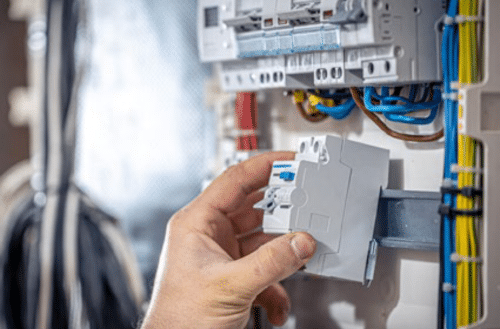
Electrician installing Miniature circuit breakers on DIN rail in distribution board

In a move aimed at protecting consumers and supporting local industry, the Department of Trade, Industry and Competition (DTIC) has introduced a Pre-Export Verification of Conformity (PVoC) Programme for certain unregulated products imported from China.

The directive applies specifically to products not already subject to compulsory specifications administered by the National Regulator for Compulsory Specifications (NRCS), filling a regulatory gap that has long allowed substandard goods to enter the market unchecked. Importers of these products will be required to obtain a Certificate of Conformity (CoC), confirming that they meet applicable South African National Standards (SANS) or recognised reference standards, with products such as electricity generators and solar panels among those included. The programme comes into effect from September 2026.

Safehouse B2B June Blog 1

The Enforcement Gap

Wimpie Lyons and Connie Jonker, Technical Specialist and Lighting Specialist respectively at Safehouse, a non-profit organisation that protects South African businesses and people from preventable harm caused by unsafe electrical products and services, share reservations about whether the new PVoC scheme can be effectively implemented without addressing underlying structural weaknesses. Having spent significant careers at the South African Bureau of Standards (SABS) before joining Safehouse, both question the scheme’s practical impact.

A key issue is market surveillance. Drawing on experience with the NRCS Letter of Authority (LOA) model, Jonker points to a structural weakness in the current regulatory approach: product approvals are based on a single type-test report valid for three to five years, with only a fraction of the regulator’s budget allocated to ongoing market surveillance testing. In his view, the regulator has both the mandate and the means to act more decisively.

“The NRCS Act, which empowers the regulator to manage technical regulations and compulsory specifications to protect public health, safety and the environment and ensure fair trade, gives the regulator the power to name and shame non-compliant suppliers, and it needs to use it. Repeated offenders should be identified and removed from the market. That is how it works globally, and it is the model we need here.”

The gazette itself acknowledges that the directive does not create new enforcement powers, relying instead on existing mechanisms through the South African Revenue Service (SARS) and the Border Management Authority (BMA). Under the programme, conformity assessment will be conducted through a cooperation arrangement between SABS and the China Certification and Inspection Group (CCIC), with SABS retaining custodianship of the CoC scheme.

Lyons is cautious about what this means in practice.

“The principle is sound, but the implementation concerns me. With Chinese labs subcontracted to issue CoCs, the paperwork will arrive with the goods, but fewer than 22% of containers entering South Africa are meaningfully inspected. A CoC risks becoming just another stamp if there is no credible system to verify what is actually in each shipment.”

The real-world consequences of weak enforcement are well documented. Importers have been known to alter materials, substituting copper conductors for aluminium, for instance, without changing the brand name or model number, making detection at the point of entry effectively impossible. Drawing on direct experience, Lyons highlights:

“We reported a non-compliant product to the NRCS, they acted, and within a week it was back on the market. That cycle repeated itself three or four times. Until enforcement has real teeth, the same pattern will continue.”

Jonker points to the European model as the benchmark worth adopting.

“The European model places the burden of proof squarely on the supplier. They test their own products, maintain auditable records, and face severe consequences, including company closure, for false declarations. That accountability is what makes it work, and it is the only model that can work here too.”

Local Manufacturers Count the Cost

These views are echoed by local manufacturers who bear the direct competitive cost of uneven enforcement. CBi-electric: low voltage Engineering Executive Dr Andrew Dickson warns that when markets begin to tolerate non-compliant products, the consequences can escalate quickly.

“With China accounting for around 35% of non-compliant electrical imports into African markets, the scale of the problem is significant. Once substandard goods are allowed in, it opens the door for even critical, life-saving products to be manufactured with poor-quality materials and sold to unsuspecting consumers. At best, they fail. At worst, they pose serious risks to infrastructure and human safety.”

This concern extends to commonly counterfeited electrical components such as cables, circuit breakers, switches and wiring accessories.

“Despite existing regulations, weak enforcement allows these products to reach the market. If goods outside compulsory specifications can enter so easily, it raises broader questions about consumer safety across the board.”

Safehouse conclusion image 2

A Positive Signal, With Caveats

Dr Dickson notes that the introduction of a CoC is nonetheless a meaningful step forward.

“It signals clear intent from government and has the potential to improve adherence to product standards, ultimately helping to protect both infrastructure and lives.”

Lyons agrees in principle:

“It’s a noble idea, if executed properly.”

Implications for New Import Safety Rules for local Industry

The implications for local industry are equally significant. Bringing a compliant electrical product to market in South Africa is a rigorous and costly process. Products subject to compulsory specifications must secure a LOA from the NRCS, alongside electromagnetic compatibility (EMC) testing and approvals from bodies such as ICASA. Safety testing alone can take between 18 and 26 weeks and cost anywhere from R30,000 to over R200,000 per product line, with ongoing renewal requirements and annual fees.

By contrast, importers of non-compliant goods bypass these requirements entirely, often benefiting from subsidies in their countries of origin that allow them to compete aggressively on price.

“Local businesses are being undercut by products that don’t meet the same standards,” observes Dr Dickson. “Our manufacturers face a lengthy and expensive compliance journey before a product reaches the shelf, while some competitors avoid it altogether. In some cases, importers operate on a fly-by-night basis, selling quickly and disappearing before they can be held accountable. This regulation presents an opportunity to begin levelling the playing field.”

He concludes:

“If properly enforced, this could help restore competitive fairness while, more importantly, improving consumer safety.”

What are the MCBs electrical characteristics e1743597563634
ENDS

About CBi-electric: low voltage

  • Established in 1949, CBi-electric: low voltage is a manufacturer and supplier of quality low voltage electrical distribution, protection, and control equipment. Previously known as Circuit Breaker Industries or CBI, the company specialises in the design, development, and manufacturing of circuit breakers, residential current devices, surge protection, wiring accessories, and metering products.
  • Headquartered in Johannesburg, South Africa, the company is a subsidiary of renowned JSE listed industrial group Reunert, established in 1888, with international operations across Africa, Asia, Australia, Europe, and USA.
  • CBi-electric: low voltage can be found in almost every home and has firmly become a market leader over the last 77 years while supplying products to authorities, utilities, manufacturers, commercial property developers, industrial, mining, telecommunications, and general power distribution applications.
  • In 2021, the brand launched its smart IoT (internet-of-things) home automation range, called the Astute Range.

For more information, go to https://cbi-lowvoltage.co.za.